

2025 Special Guide!
Have you ever gazed at the night sky and wondered, “What’s out there beyond the stars?” 🌙✨ Our Earth is not alone—it belongs to a big family called the Solar System. This magical neighborhood is filled with planets, moons, comets, asteroids, and of course, our star—the Sun.
In 2025, scientists have made some exciting new discoveries about our cosmic home. From finding new moons around Saturn and Uranus to spotting a rare comet from another star system, the Solar System is more alive than ever. Let’s take a journey together and explore it in the most fun way possible! 🚀
☀️ Meet the Sun – Our Super Star
At the center of it all is the Sun, the boss of the Solar System. It’s not just important—it’s everything. Without the Sun, Earth would be a frozen, lifeless rock.
- The Sun is a giant ball of hot gases (mainly hydrogen and helium).
- It’s so huge that you could fit 1.3 million Earths inside it.
- Its gravity is like a powerful magnet, keeping all the planets in orbit.
🌟 Latest 2025 Update:
In 2025, the Solar Orbiter spacecraft captured the first-ever images of the Sun’s poles. This is a big deal because these poles control the Sun’s magnetic field. Scientists say it will help us predict solar storms that can affect Earth’s satellites, GPS, and even internet connections.
🪐 The 8 Planets – Our Space Neighbors
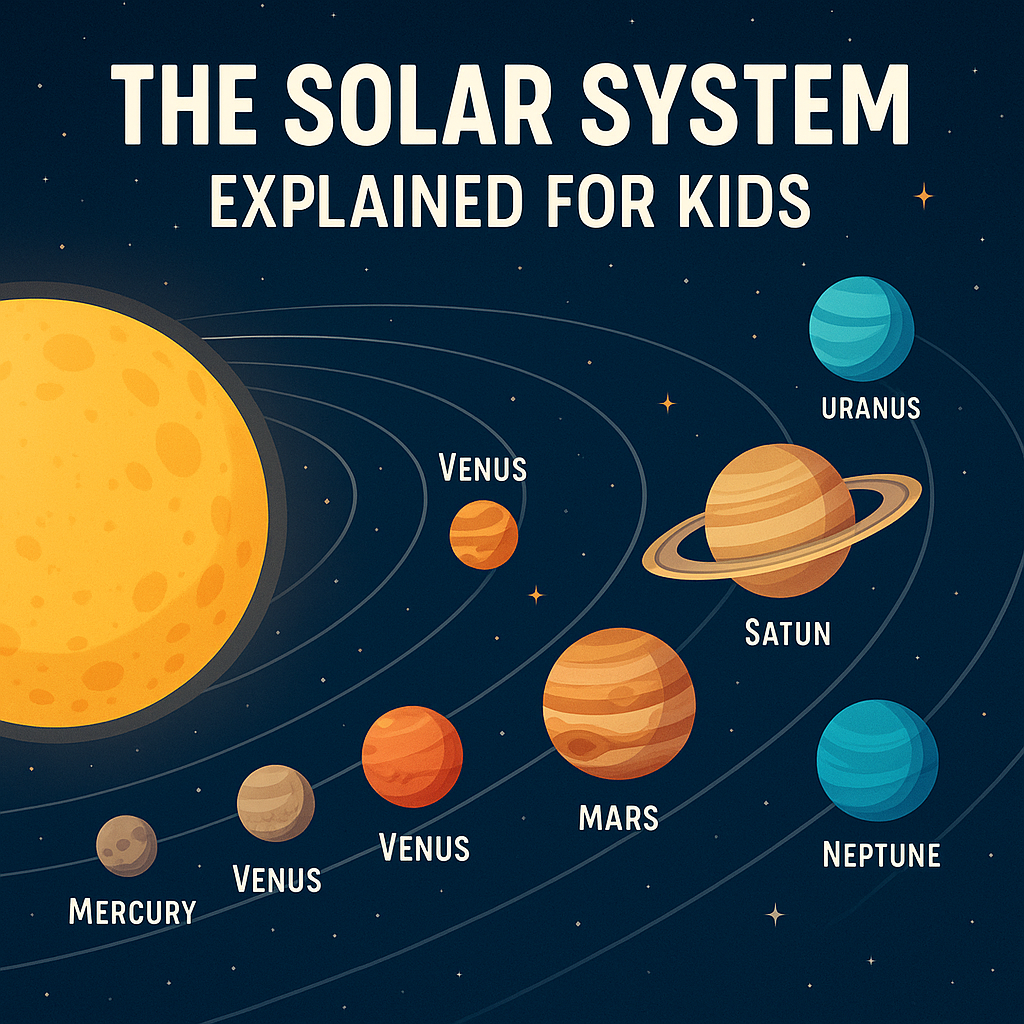
Our Solar System has eight planets, each one unique. Let’s meet them in order from the Sun:
1. Mercury 🌑
- Closest planet to the Sun.
- A day here lasts 59 Earth days.
- Super hot during the day and freezing cold at night.
2. Venus 🌟
- Covered in thick yellow clouds of poisonous gas.
- Spins backward, so the Sun rises in the west!
- Called Earth’s “twin” because it’s similar in size.
3. Earth 🌍
- Our home planet—the only place we know with life.
- Has land, air, and water in all three forms: solid, liquid, and gas.
- Earth has a companion now—scientists in 2025 discovered a mini “second moon” asteroid called 2025 PN7 orbiting with us.
4. Mars 🔴
- The Red Planet.
- Known for its dusty surface and the tallest volcano in the Solar System, Olympus Mons.
- Space agencies are preparing human missions to Mars by the 2030s. Robots are already roaming its surface today.
5. Jupiter 🌪️
- The biggest planet in the Solar System.
- Could fit 1,300 Earths inside it.
- Has a storm called the Great Red Spot that’s been blowing for more than 300 years.
6. Saturn 💍
- Famous for its beautiful rings made of ice and rocks.
- 🌟 2025 Update: Scientists just discovered 128 new moons around Saturn, bringing the total to 274 moons—more than any other planet!
7. Uranus ❄️
- Blue-green and icy.
- Spins on its side like a rolling ball.
- 🌟 2025 Update: A brand-new moon called S/2025 U1 was found orbiting Uranus.
8. Neptune 🌊
- The farthest planet from the Sun.
- Dark, cold, and windy.
- Its winds can blow at 2,100 km/h—faster than the speed of sound!
🌑 Beyond the Planets – Moons, Asteroids & Comets
Our Solar System isn’t just planets—it’s full of other amazing things too:
- Moons: Natural satellites. Earth has one, but Jupiter and Saturn have dozens.
- Asteroids: Giant space rocks, mostly found in the asteroid belt between Mars and Jupiter.
- Comets: Icy wanderers that grow glowing tails when near the Sun.
🌟 2025 Update:
- Astronomers spotted a rare interstellar comet called 3I/ATLAS entering our Solar System. This comet came from another star system, making it incredibly special.
- Earth’s new space buddy, 2025 PN7, travels with us like a mini second moon.
🌬️ The Heliosphere – Our Solar Bubble
Imagine a giant invisible bubble surrounding the whole Solar System. That’s the heliosphere, created by the Sun’s solar wind. It shields us from harmful cosmic rays.
🌟 2025 Update:
NASA’s IMAP mission launched this year to study the heliosphere’s edges. This will help protect astronauts on future deep-space missions.
🌱 Baby Solar Systems – Planets Being Born
Our Solar System is old, but new ones are still forming in the universe.
🌟 2025 Discovery:
Astronomers using the James Webb Space Telescope saw the birth of a new solar system around a star called HOPS-315. Dust and gas were clumping together—just like how our Solar System started 4.5 billion years ago.
Also, by 2025, scientists have confirmed over 6,000 exoplanets (planets orbiting other stars). Some might even be Earth-like!
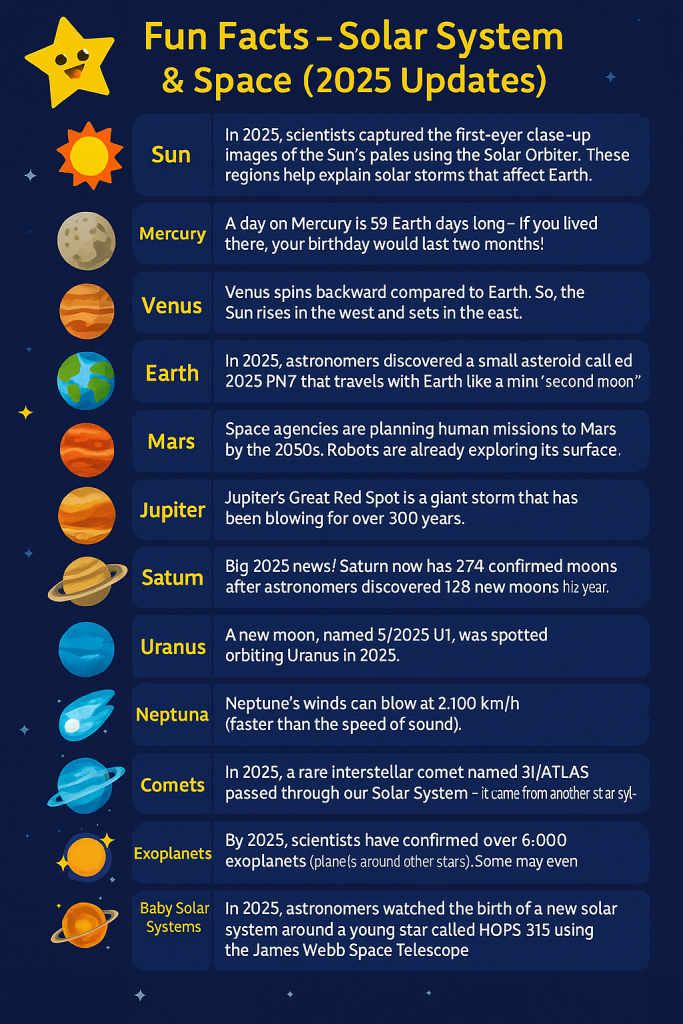
✨ Fun Facts Table – Solar System & Space (2025 Updates)
| ⭐ Topic | 🌟 Fun Fact (2025 Latest) |
|---|---|
| Sun | First-ever images of the Sun’s poles taken in 2025 by the Solar Orbiter. |
| Mercury | A day here lasts 59 Earth days—almost two months! |
| Venus | Spins backward, so the Sun rises in the west. |
| Earth | In 2025, a mini “second moon” asteroid, 2025 PN7, was discovered traveling with Earth. |
| Mars | Human missions to Mars are planned for the 2030s. |
| Jupiter | Its Great Red Spot storm has been raging for 300+ years. |
| Saturn | Big 2025 news—128 new moons discovered, making 274 in total! |
| Uranus | A new moon, S/2025 U1, was spotted this year. |
| Neptune | Winds blow faster than the speed of sound—2,100 km/h! |
| Comets | A rare interstellar comet (3I/ATLAS) visited in 2025. |
| Exoplanets | Over 6,000 exoplanets confirmed by 2025. |
| Baby Solar Systems | In 2025, astronomers watched new planets forming around HOPS-315. |
| Heliosphere | NASA’s IMAP mission launched to study our Solar System’s protective bubble. |
🌍 Why Learning About Space is Important
Studying the Solar System isn’t just about stars and planets—it’s about understanding our own planet better:
- It helps predict dangerous solar storms.
- It teaches us about Earth’s climate and weather.
- It prepares us for future space travel.
- It inspires kids (like you!) to dream big—maybe the next astronaut, scientist, or space explorer is reading this right now.
🌌 Final Thought
The Solar System is not just our cosmic home—it’s a living classroom. With every new discovery in 2025, scientists remind us how much we still don’t know. From Saturn’s endless moons to comets visiting from other stars, space is full of surprises.
So the next time you look at the night sky, remember: 🌠 You’re part of this giant, magical universe. Who knows—maybe one day, you’ll be the one making the next big discovery! 🚀✨

0 Comments